
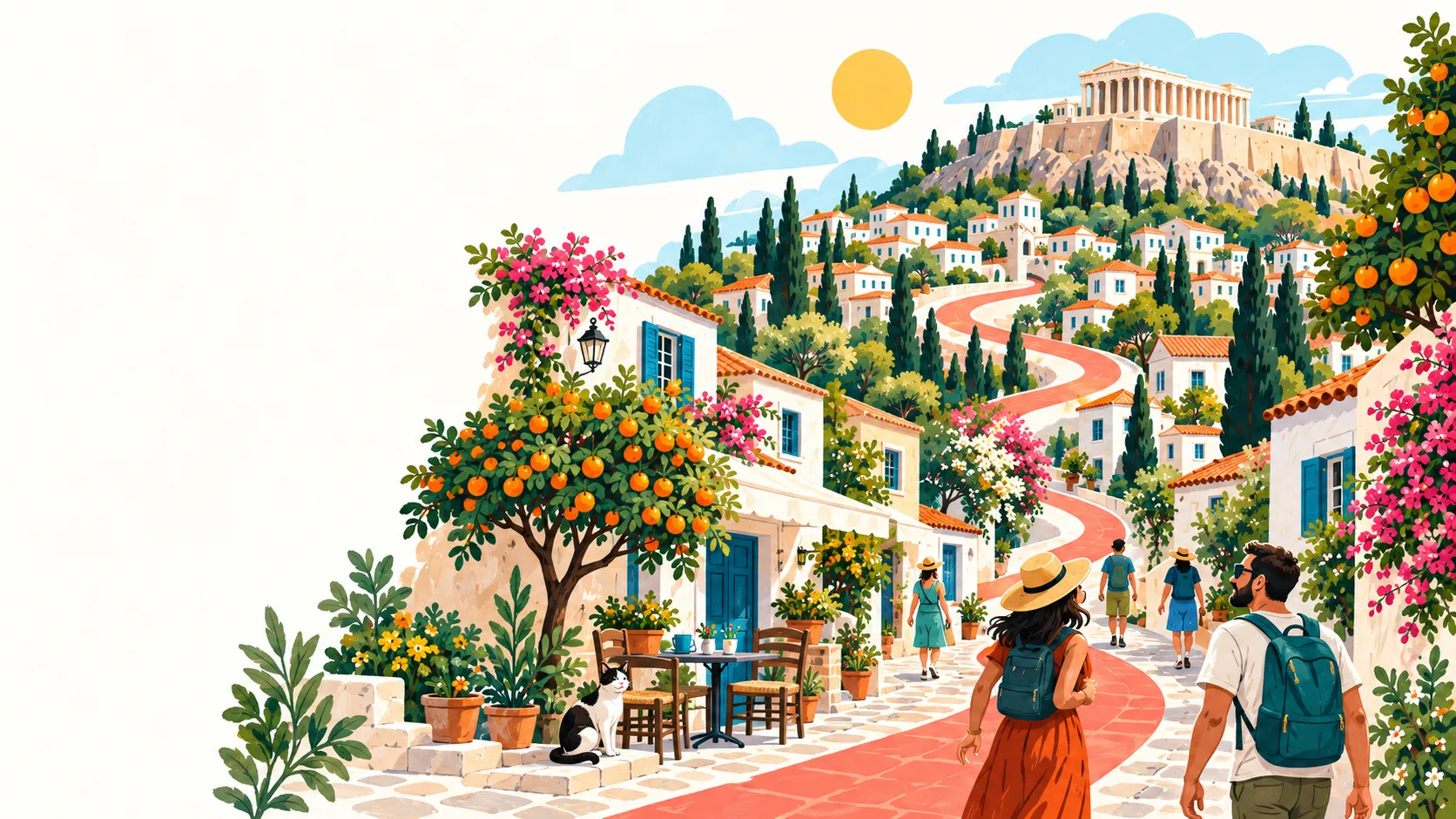
Most visitors who search for things to do in Athens get a list of landmarks. The city makes more sense on foot, because its main sights sit close together and each neighbourhood has its own character. This guide walks through the central areas one at a time, so you can pick a few and take your time.
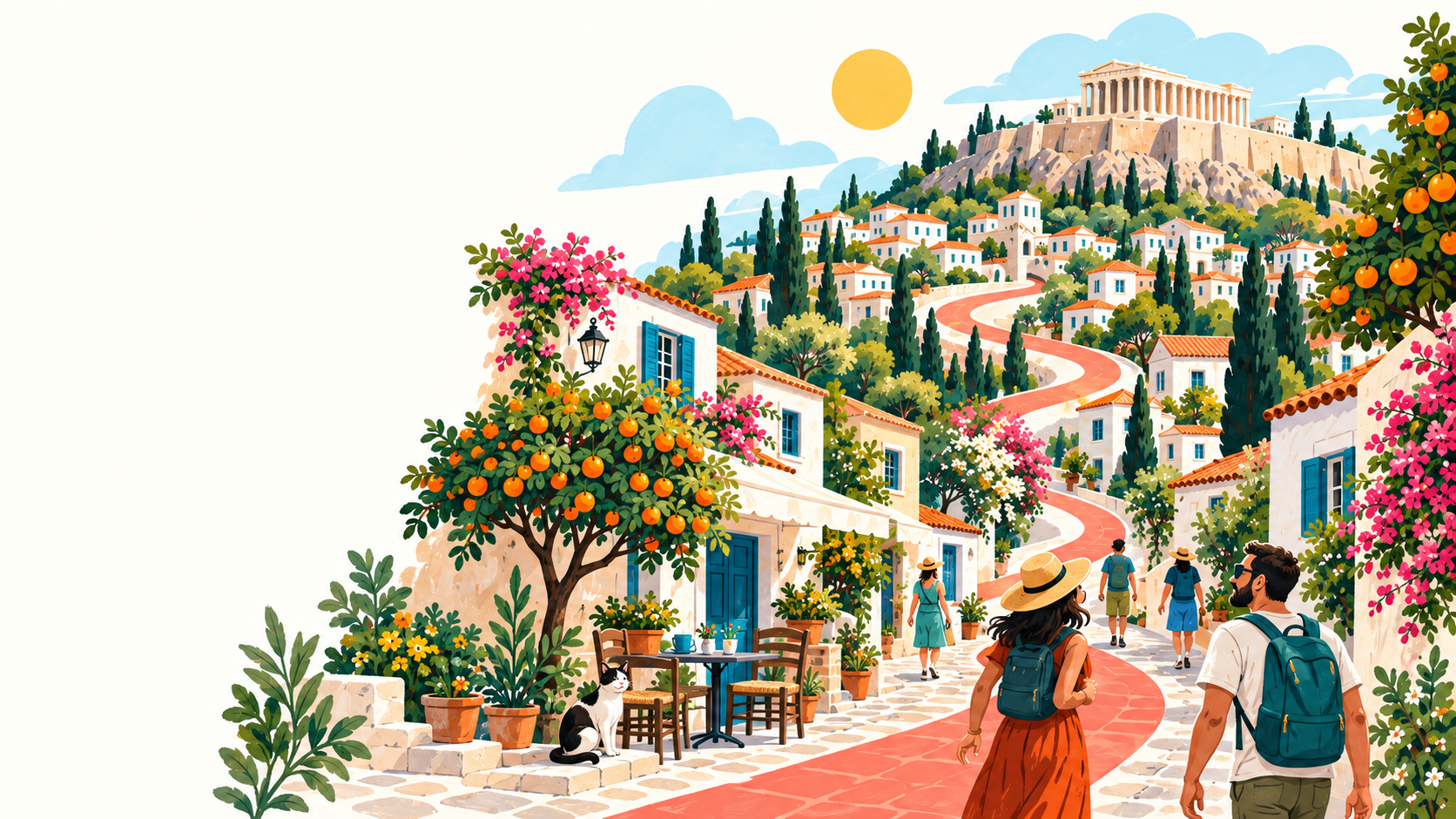
Why walk Athens?
The historic centre is compact. The Acropolis, the ancient marketplace, the old quarters and several museums can all be reached on foot from one another. Walking also lets you find the small things a bus tour skips: a shaded square, a neighbourhood bakery, a view that opens up at the end of a lane.
Bring comfortable shoes with good grip, because the marble paving near the ancient sites can be slippery. Bring water and sun protection too. Summers in Athens are hot, so early morning and late afternoon are the most comfortable times to be outside.
1. Plaka and Anafiotika: the old town below the Acropolis
Plaka is the best starting point. Its lanes climb the northeastern slope beneath the Acropolis, and many of its streets are pedestrian-friendly. Wander without a fixed route and you will pass neoclassical houses, small churches and cafés with outdoor tables.
Higher up lies Anafiotika, a small cluster of whitewashed houses with flowering courtyards. It feels closer to a Cycladic island village than to a capital city. The area is residential, so keep your voice down and be considerate when taking photos.
2. The Acropolis and the Acropolis Museum
The Acropolis is the reason many people come to Athens, and the Parthenon is its best-known monument. Check opening hours, ticketing and any visitor-flow rules on the Hellenic Ministry of Culture’s official site before you go, since these change.
At the foot of the hill, the Acropolis Museum displays finds from the site. It makes a good indoor stop in the heat of the day, and a good way to understand what you saw on the rock. Check current opening hours and ticket information with the museum before visiting.
The pedestrian avenue Dionysiou Areopagitou runs around the south side of the hill and links the museum area with Thissio. It is a pleasant, mostly traffic-free stretch for walking.
3. Koukaki and Makrygianni: a local base
South of the Acropolis, Koukaki is a residential neighbourhood with cafés, bakeries and small restaurants, and it is within walking distance of the museum. It is popular with visitors who want a calmer base than the busiest tourist streets. If you are planning where to stay or where to start your day, explore the area at your own pace.
4. Thissio and the Ancient Agora
Thissio is the neighbourhood to the northwest of the Acropolis, with a lively pedestrian street and views up to the hill. Nearby, the Ancient Agora was the civic and commercial heart of the ancient city. The Temple of Hephaestus, one of the best-preserved ancient temples in Greece, stands on its edge. The site also has a museum in the reconstructed Stoa of Attalos.
5. Monastiraki and Psyrri: markets and evening energy
Monastiraki is busy and colourful, built around its square, its flea-market streets and the surrounding shops. Hadrian’s Library is close by. Go in the morning for a calmer experience.
Psyrri, just north, is a compact grid of lanes known for street art, small bars and tavernas. It is better in the evening, when the area fills with locals. As in any busy area, keep an eye on your bag in crowds.
6. Syntagma, the National Garden and the Panathenaic Stadium
Syntagma Square faces the Parliament building, where the ceremonial guards (Evzones) stand. Check the schedule for the larger ceremonies if you want to see one.
Behind the Parliament, the National Garden offers shade and a quiet break. From there it is a short walk to the Panathenaic Stadium, an all-marble stadium associated with the first modern Olympic Games in 1896.
7. Kolonaki and Lycabettus Hill
Kolonaki is a stylish central district with boutiques, galleries and cafés. From its upper streets, a path leads up Lycabettus Hill, the highest point in central Athens. The climb is steep, so go slowly and bring water. The view over the city and towards the sea is worth it, especially near sunset.
A sample day on foot
You don’t need to see everything. One easy order is:
- Morning: Plaka and Anafiotika, then the Acropolis.
- Midday: Acropolis Museum, followed by lunch in Koukaki or along the pedestrian avenue.
- Afternoon: Thissio and the Ancient Agora, then Monastiraki.
- Evening: Psyrri for dinner, or Lycabettus Hill for sunset.
Practical tips
- Start early at the major archaeological sites. They are quieter and cooler.
- Allow time for breaks. Athens rewards a slow pace.
- Opening days and hours of museums and sites vary and can change, so check official pages before you go.
- Dress for walking, and cover your shoulders and carry a hat in summer.
Other ways to explore Greece from Athens
Many visitors search for things to do in Greece starting from Athens. The city is a convenient base for the wider country, but it deserves a couple of unhurried days of its own first.
Related reading on things to do in athens
- Plaka, Monastiraki and Psyrri: a self-guided walk
- One Day in Athens on Foot: A Flexible Walking Plan
- Athens street art walk: Psyrri to Metaxourgeio
Sources
- Hellenic Ministry of Culture, Odysseus portal: odysseus.culture.gr (Acropolis, Ancient Agora, opening hours and tickets)
- Acropolis Museum official website: theacropolismuseum.gr
- Visit Greece, the Greek National Tourism Organisation: visitgreece.gr
Image suggestions with alt text
- Whitewashed lane with flowers in Anafiotika. Alt: “Narrow whitewashed lane with flowering plants in Anafiotika, Athens”
- View of the Parthenon from a pedestrian street. Alt: “The Parthenon on the Acropolis seen from a walking path in Athens”
- Temple of Hephaestus in the Ancient Agora. Alt: “Temple of Hephaestus in the Ancient Agora of Athens”
- Café tables in a Plaka street. Alt: “Outdoor café tables on a quiet street in Plaka, Athens”
- Sunset view from Lycabettus Hill. Alt: “Athens skyline at sunset from Lycabettus Hill”